Why Ireland works for international students
Ireland is the only English-speaking country remaining in the European Union, which is a bigger deal than it sounds. You study in English, graduate with a qualification recognised across the EU, and sit inside the European market that multinationals use as their base for the region. Google, Meta, Pfizer, Intel, Stripe and Medtronic all run major operations from Dublin, Cork and Galway — and they hire graduates locally.
For students from India and the wider region, three things usually tip the decision: teaching is in English, the post-study stay-back is generous, and the country is small enough that a graduate in Dublin can interview in Cork the same week. Class sizes are modest, and most master's programmes run for a single year, which keeps the total cost of the qualification down compared with two-year programmes elsewhere.
Choosing a university and a course
Irish higher education splits into universities, technological universities and colleges. All of them award qualifications on the National Framework of Qualifications, so the distinction matters less than the fit between the course and the career you want.
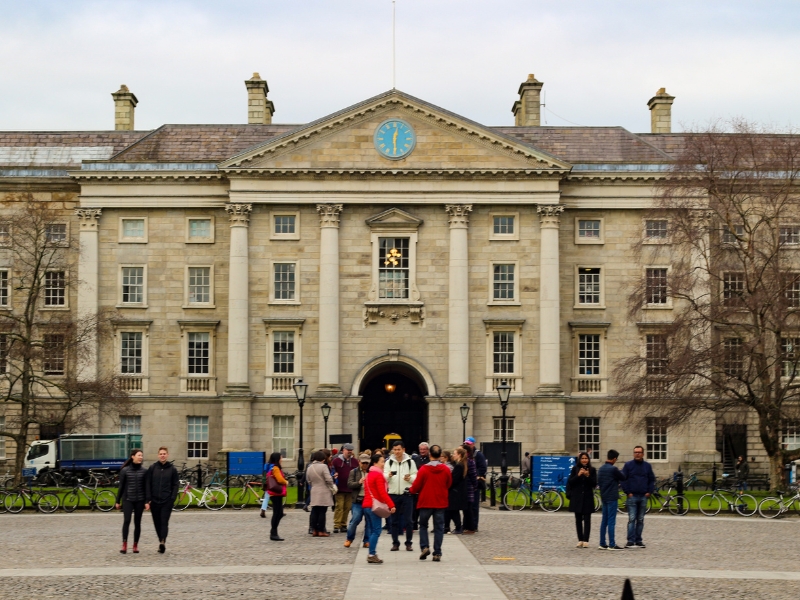
- Trinity College Dublin, University College Dublin, University College Cork, University of Galway, Maynooth and University of Limerick — research-led universities with the strongest international rankings and the most competitive entry.
- Technological universities (TU Dublin, Munster TU, South East TU, Atlantic TU) — strongly applied programmes with close industry links, often more accessible entry requirements and lower fees.
- Private colleges such as Dublin Business School, Griffith College and National College of Ireland — flexible intakes (September and January), business, computing and pharma-facing programmes.
Pick the course before the brand. Employers in Ireland hire against the module list, and a well-matched programme at a technological university will beat a loosely related course at a higher-ranked institution.
Practical tip
Check whether your programme includes a work placement or an industry project. Placements are the single most reliable route into a graduate job in Ireland, because they put you inside a company before the graduate hiring round opens.
Entry requirements
For a taught master's, most institutions expect a recognised bachelor's degree with a second-class honours equivalent, plus evidence of English proficiency. Typical English scores are IELTS 6.5 overall with no band below 6.0, PTE Academic around 63, or an equivalent Duolingo score where accepted. Some programmes accept a medium-of-instruction letter, but relying on that is risky — the visa office may still want a test.
Competitive courses in computing, data analytics and pharmaceutical sciences often ask for a related primary degree. If your background is different, look for conversion programmes explicitly designed for career changers rather than applying to a specialist course and hoping.
Not sure which test to take? Our comparison of IELTS, PTE and Duolingo covers scoring, cost and turnaround time.
What it actually costs
Tuition varies widely by institution and discipline. The figures below are indicative annual ranges for non-EU students and should be confirmed against the course page before you budget.
| Cost | Typical range (per year) | Notes |
|---|---|---|
| Taught master's tuition | €12,000 – €25,000 | Business and computing sit mid-range; medicine and some sciences run far higher |
| Accommodation | €700 – €1,300 / month | Dublin is the outlier; Cork, Galway and Limerick are meaningfully cheaper |
| Living costs | €500 – €700 / month | Food, transport, phone, social — excluding rent |
| Private medical insurance | €150 – €500 / year | Required for the student visa |
For a month-by-month breakdown of what students actually spend once they arrive, see our guide to the cost of living in Ireland.
The student visa (Stamp 2)
Non-EEA students studying a full-time programme of at least one academic year apply for a long-stay study visa, and register on arrival for Stamp 2 permission. The core requirements are an unconditional letter of acceptance, evidence that tuition has been paid, private medical insurance, and proof of funds — currently €10,000 available to you for the year, plus evidence you can cover subsequent years if the course is longer.
Applications are made online and then submitted with supporting documents to the relevant visa office. Processing times move with demand, so a summer intake application submitted in July is a much riskier proposition than the same application submitted in April. Our Ireland student visa checklist walks through every document, in the order the visa officer reads them.
The most common refusal reason
Finances that cannot be explained. A large sum that appeared in an account three weeks before the application, with no documented source, is the fastest way to a refusal. Build and document your funds over months, not days.
Working while you study
Stamp 2 permission allows 20 hours of casual work per week during term, and 40 hours per week during designated holiday periods (typically June to September, and mid-December to mid-January). That income helps with living costs but will not fund tuition — plan your budget on the assumption that part-time work covers groceries and transport, not fees.
After graduation: the stay-back route
Graduates of eligible programmes can apply for the Third Level Graduate Programme, which grants Stamp 1G permission to look for and take up employment: 12 months for level 8 graduates and 24 months for level 9 and above, subject to the overall limit on time spent on a student permission. During that period you can work full time without an employment permit, which is exactly the window employers use to convert graduates onto a Critical Skills Employment Permit.
We cover the timing, the paperwork and the transition to an employment permit in detail in Ireland's post-study work visa explained.
Bringing family with you
Student permission does not, by itself, give your spouse or children the right to join you and work. Dependant rights in Ireland are tied closely to the permission the sponsor holds — they are far stronger once you hold a Critical Skills Employment Permit than while you are still a student. If family reunification is part of your plan, sequence it correctly from the start: read our Ireland dependant visa guide before you commit to a course.
A realistic timeline
- 12–10 months before intake: shortlist courses, sit your English test, request transcripts.
- 10–8 months: submit applications; chase references and academic documents.
- 8–6 months: accept an offer, pay the deposit, and start documenting funds.
- 6–4 months: pay tuition in full, obtain the unconditional acceptance letter, buy medical insurance, submit the visa application.
- 3–1 months: secure accommodation, book flights, prepare for arrival and immigration registration.
Every step above has a dependency on the one before it. The applications that fail are rarely the weak ones — they are the late ones.
Planning a move to Ireland?
F2S International has guided students through Irish admissions, visas and job placement for over a decade, from our base in Dublin. Tell us your background and we will tell you honestly what is realistic.